


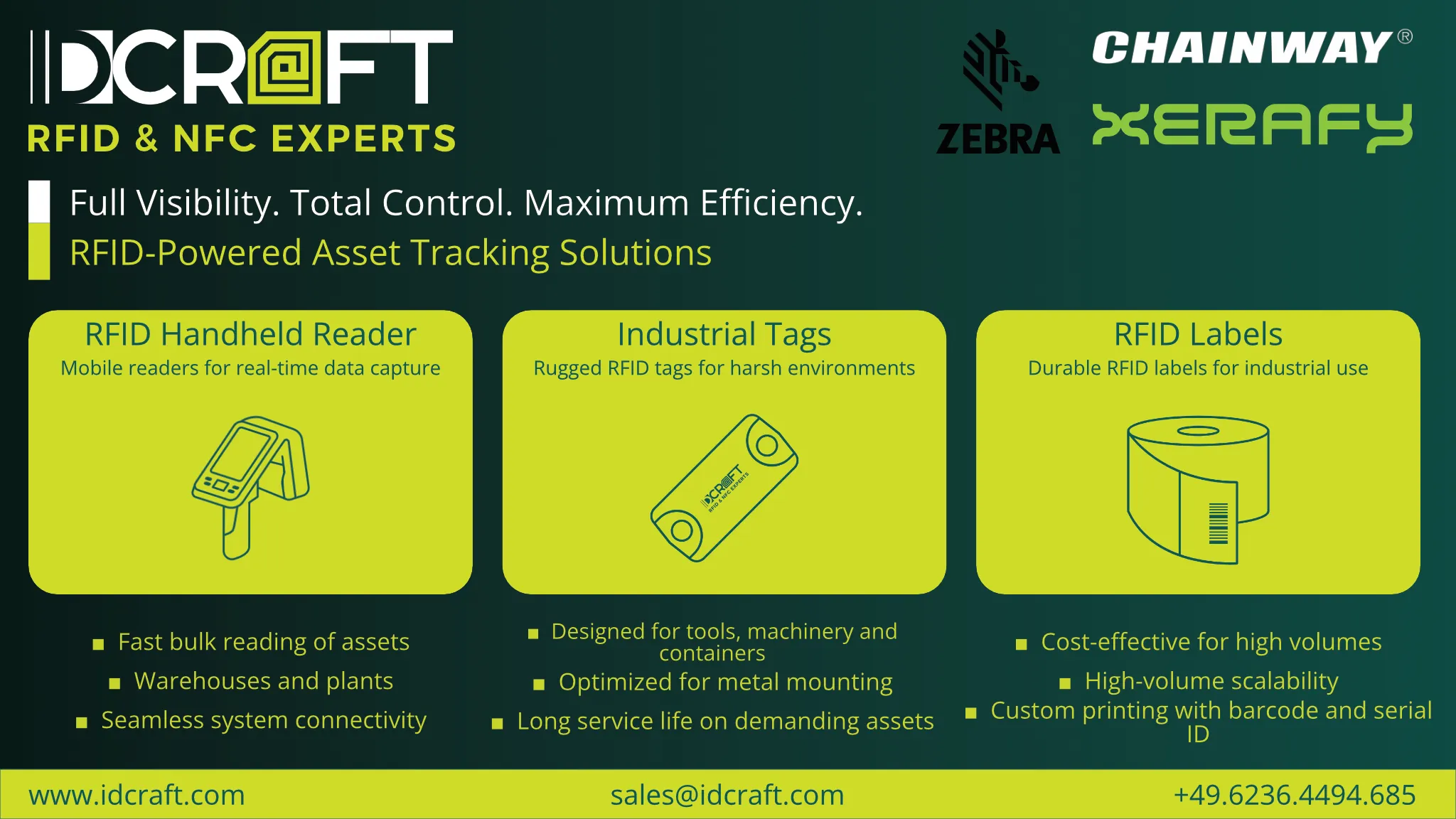
Foundations, Technologies and Strategic Value
Definition
Asset tracking refers to the process of monitoring and managing physical assets throughout their lifecycle — from acquisition and deployment to maintenance and disposal. Organizations across industries such as logistics, healthcare, manufacturing, and retail rely on asset tracking to maintain visibility over equipment, inventory, tools, and other valuable items. Without effective tracking, businesses face inefficiencies, lost assets, compliance risks, and unnecessary replacement costs.
Traditional tracking methods like manual spreadsheets or barcode scanning are time-consuming and error-prone. Barcodes require direct line-of-sight scanning, making large-scale inventory processes slow and labor-intensive. This is where RFID (Radio Frequency Identification) technology offers a transformative advantage.
RFID uses radio waves to automatically identify and track tags attached to assets. Unlike barcodes, RFID tags can be read without line of sight, at greater distances and multiple tags can be scanned simultaneously. A single UHF RFID reader can capture hundreds of tagged items per second, dramatically reducing the time needed for inventory counts and audits.
RFID is important for asset tracking for several key reasons. First, it delivers real-time visibility: organizations know exactly where their assets are at any given moment. Second, it significantly reduces human error by automating data capture. Third, RFID enables scalability — whether tracking hundreds or millions of items, the technology handles high volumes effortlessly. Fourth, RFID supports lifecycle management by recording each asset's movement, usage history, and maintenance status, enabling data-driven decision-making.
Industries such as healthcare use RFID to track surgical instruments and medication, while logistics companies monitor pallets and containers across global supply chains. In manufacturing, RFID ensures tools and work-in-progress items are always accounted for.
In summary, Asset tracking refers to the digital monitoring and management of physical assets throughout their lifecycle. This includes machinery, tools, vehicles, IT equipment, containers and medical devices. RFID technology elevates asset tracking from a reactive, manual task to a proactive, automated process — saving time, reducing costs, and improving operational efficiency.
The objective is to ensure transparency regarding:
- Location
- Condition
- Usage
- Responsibility
Technological Foundation
A central technology is RFID. Depending on requirements, different frequency ranges are used:
Relevant standards include ISO 15693, ISO 14443 and EPC Gen2.
A complete solution includes:
- RFID tags
- RFID readers
- Middleware
- ERP integration
Additional technologies such as GPS, BLE or UWB may complement the system.
Business Impact
Asset tracking reduces:
- Search times
- Loss rates
- Replacement costs
At the same time, it increases:
- Inventory accuracy
- Transparency
- Process reliability
Real-time data enables predictive maintenance, automated bookings and compliance documentation.
Industry Use Cases
Manufacturing, construction, healthcare and IT environments all benefit from structured asset visibility.
Integration as a Success Factor
Asset tracking is not merely a hardware deployment but a system integration project requiring:
- Process definition
- IT architecture
- Interfaces
- Scalability
IDCRAFT positions itself as an RFID and NFC specialist, supporting companies from strategy to operation. Want to learn more, contact us for a first meeting!


