


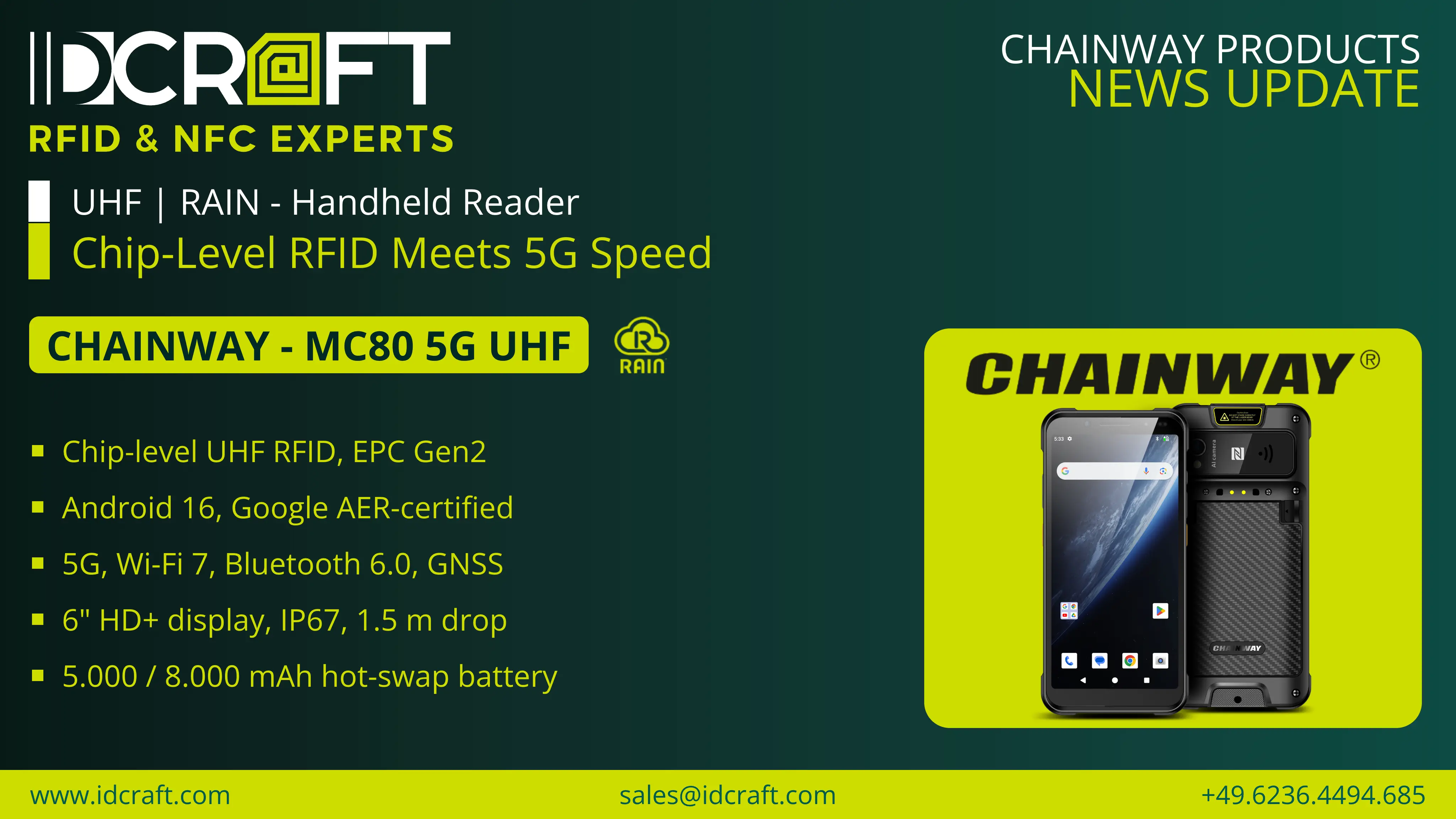
Chainway MC80: what happens when the RFID reader moves into the processor
The Chainway MC80 is one of the first handhelds where UHF RFID is no longer built in as an add-on module but sits directly in the application processor. Here is what that means technically, where the strengths are and where the limits.
The starting point: why RFID handhelds used to be thick
Anyone who bought a UHF RFID handheld in recent years always paid for two devices in one housing: an Android terminal and an RFID reader module. The module, typically an Impinj E710 or comparable, needs space for its board, space for the antenna, its own power supply and above all an RF design that coexists with LTE, WLAN and Bluetooth in the same housing.
The result is familiar from daily practice: devices noticeably deeper and heavier than a standard industrial smartphone. For pistol-grip devices built for bulk reading that is perfectly fine, there the form factor is the point. For applications where the device is carried all day and also used for calls, photos and barcodes, it was always a compromise.
What the Qualcomm Dragonwing Q-6690 changes
In August 2025 Qualcomm introduced the Dragonwing Q-6690, according to the manufacturer the world's first enterprise mobile processor with a fully integrated UHF RFID reader. The reader supports RAIN RFID per ISO/IEC 18000-63 and is Gen2X-capable.
Two points stand out technically:
No external RF chain. The reader shares the chip's existing RF infrastructure. That shortens the bill of materials and cuts coexistence effort: 5G, Wi-Fi 7, Bluetooth 6.0, UWB and RFID are coordinated centrally instead of being shielded against each other.
Software-configurable feature packs. Qualcomm lets OEMs add capabilities via over-the-air update without changing the hardware. That matters for enterprise lifecycle planning: devices stay current longer and re-certifications are avoided.
As first OEM partners Qualcomm named Zebra, Honeywell, Urovo, HMD Secure and CipherLab at the time. With the MC80, Chainway is now among the manufacturers shipping actual devices on this platform.
Form factor and ergonomics
165 × 76.8 × 15.5 mm at 283 grams including battery. That is the headline figure of this device and the real reason to look at it: a UHF-capable handheld at this depth simply did not exist before.
The 6-inch display ships with 720 × 1612 pixels (HD+) as standard, optionally 1080 × 2160 (FHD+). Corning Gorilla Glass, multi-touch, operation with wet hands and gloves; rubber, nylon and cotton are covered according to Chainway.
Computing and operating system
The octa-core processor runs at 2.0 GHz in the base configuration; up to 2.9 GHz can be configured optionally. On-device AI delivers 2 TOPS, optionally up to 6 TOPS. Memory ranges from 4 GB RAM + 64 GB UFS to 16 GB + 256 GB, plus a microSD slot for up to 2 TB.
The operating system is Android 16 with Google AER certification, upgradeable to Android 20 according to Chainway. For procurement cycles with multi-year depreciation this update path is often the deciding criterion, and it is unusually long here. That makes the MC80 an RFID handheld on Android 16 that carries several major versions across its lifecycle.
Development runs through the Chainway SDK in Java, with Android Studio or Eclipse.
Data capture: UHF, NFC, barcode, camera, UWB
- UHF RFID: chip-integrated in the Qualcomm Dragonwing Q-6690, RAIN / ISO/IEC 18000-63, Gen2X-capable
- NFC: 13.56 MHz, ISO 14443A/B, ISO 15693, NFC-IP1/IP2, SoftPOS supported, 2–4 cm range
- Barcode (optional): Zebra SE4710 / SE4720 / SE4770 / SE55 (long range) or CM60, 1D and 2D including DPM
- Camera: 50 MP rear (PDAF, HDR, flash), 8 MP front
- UWB (optional): centimeter-level indoor positioning including orientation
The combination of UHF, NFC and SoftPOS in one slim device is remarkable for retail: stocktaking, goods verification and card payment run on the same hardware. How an RFID reader physically captures transponders is covered in our know-how article on RFID readers.
Connectivity
5G, Wi-Fi 7 with 2×2 MIMO and fast roaming, Bluetooth 6.0 with BLE. On the GNSS side GPS, BeiDou, GLONASS, Galileo and QZSS are integrated, A-GPS with XTRA support. The device comes in separate variants for EMEA and the Americas; for European deployment, order the EMEA version.
Power and ruggedness
5,000 mAh as standard, optionally 8,000 mAh. Both batteries are hot-swappable and support QC4.0 and PD3.0 fast charging, plus battery management with health monitoring.
- Drop test: MIL-STD-810H, 1.5 m without a case, 2.0 m with rubber boot
- Tumble: 2,000 falls from 0.5 m (IEC)
- Sealing: optional IP65 / IP67 (IEC)
- Temperature: operating −20 °C to +50 °C, storage −40 °C to +70 °C
- ESD: ±15 kV air, ±8 kV contact
A note for tender practice: sealing is listed as optional in the datasheet. If you need IP67, specify it explicitly when configuring the device.
Where the MC80 belongs, and where it does not
Chip-level integration does not solve every problem, so a sober assessment helps.
Well suited to processes with short to medium range and heavy mixed use: goods verification in retail, asset management, medical device and batch tracking, incoming goods inspection, maintenance. Anywhere staff switch between barcode scan, NFC badge, photo, phone call and RFID, and a second device is not an option.
No automatic replacement for dedicated bulk readers. If you want to capture pallets in passing or run shelf inventories over several metres, you will keep working with devices such as the Chainway C66 UHF Sled with pistol grip and up to 30 m read range, or a classic UHF handheld such as the Chainway MC51. Physics cannot be integrated away: antenna gain and transmit power set the range, and a 15.5 mm housing limits the antenna area.
Chainway has not yet published concrete range or bulk-read figures for the MC80. For us that is the open point we will clarify first in testing, with real transponders on real materials rather than under ideal conditions.
Availability and next steps
Chainway officially introduced the MC80 on 30 July 2026. The first public showing is at IOTE 2026 in Shenzhen, 26–28 August 2026.
IDCRAFT brings the MC80 to the DACH market as an authorized Chainway distributor. We advise on configuration, help decide which device class fits your process and provide test devices including suitable transponders. Full specifications and the datasheet are on the Chainway MC80 UHF product page; book a consultation via the contact form or directly on +49 6236 4494 685.
Frequently asked questions about the Chainway MC80
What does chip-level RFID mean on the MC80?
The UHF RFID reader is part of the Qualcomm Dragonwing Q-6690 application processor. No separate RFID module is built in. That reduces device depth, weight and the effort of radio coexistence with 5G, WLAN and Bluetooth.
Which RFID standard does the MC80 support?
The integrated reader supports RAIN RFID per ISO/IEC 18000-63 (EPC Gen2) and is Gen2X-capable according to Qualcomm. Compatibility covers common tag IC families such as Impinj M700/M800 and NXP UCODE.
Is the MC80 suitable for bulk reading?
For short to medium distances, yes. For high-volume bulk capture over several metres, pistol-grip devices with larger antennas remain the technically better choice. Concrete range figures are not yet available at launch.
Which variant do I need for Germany?
The EMEA version. Chainway ships the MC80 in separate variants for EMEA and the Americas with different cellular bands.
How long will the MC80 receive updates?
Chainway states an upgrade path from Android 16 to Android 20. The Q-6690 is part of the Qualcomm Product Longevity Program with long-term software support.
Is the MC80 waterproof?
IP65 and IP67 are available as options and must be configured at ordering. The MIL-STD-810H drop test over 1.5 m is standard.


