


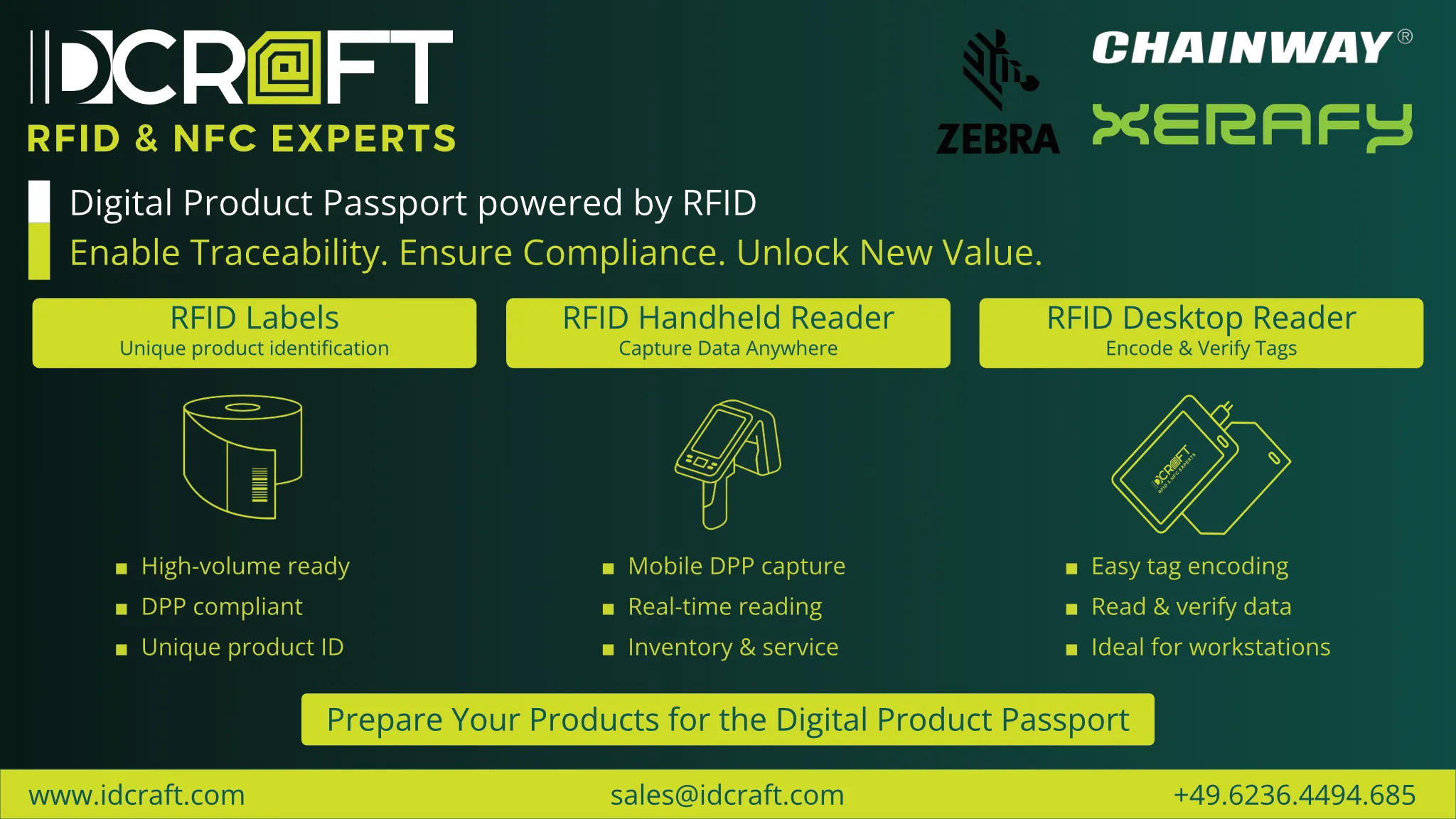
Digital Product Passport (DPP) – Why RFID Technology Can Help You Provide More Sustainable Products & More Efficient Processes
From 2027, the DPP will gradually become mandatory for product groups such as batteries, electronics, textiles, and packaging. The EU requires all relevant data to be machine-readable, permanently available, and interoperable. Manufacturers, retailers, and recycling facilities must have access throughout the product lifecycle.
So why is RFID a key technology for the introduction of the DPP?
RFID tags link the physical product to its digital twin. HF | NFC - RFID is ideal for customer interactions and maintenance, while UHF | RAIN - RFID allows automated mass identification in industrial and logistics environments. Both can even share a single chip, as shown in our article on dual-frequency labels for the Digital Product Passport.
Benefits of RFID-Based DPP Implementation:
- Efficiency: Automated data capture accelerates processes, reduces errors, and lowers costs.
- Sustainability & Circular Economy: Enables returns, refurbishment, and recycling.
- New Business Models: Product-as-a-Service, leasing, and maintenance services.
- Transparency & Customer Loyalty: Consumers recognize sustainable products; brands benefit.
- Compliance & Risk Minimization: Early adoption avoids sanctions and facilitates supply chain integration.
Which RFID Factors Are Key to Implementing a Digital Product Passport?
- Most important is choosing the right tag or label. This is highly related to the type of product you have.
- Secondly, you have to think about programming and encoding the transponders. Are you going to do this during the manufacturing process? Then you have to choose the right stationary reader, e.g., a device with Ethernet connectivity.
- If you want to apply a product label after the production process, it might be wise to choose a label printer with an integrated encoding function.
- Last but not least, you can use an handheld reader for your warehouse and logistics processes.
IDCRAFT can support you with the right hardware and know-how for your DPP journey. Leverage RFID technology for transparency, efficiency, and sustainability. Contact IDCRAFT!


