


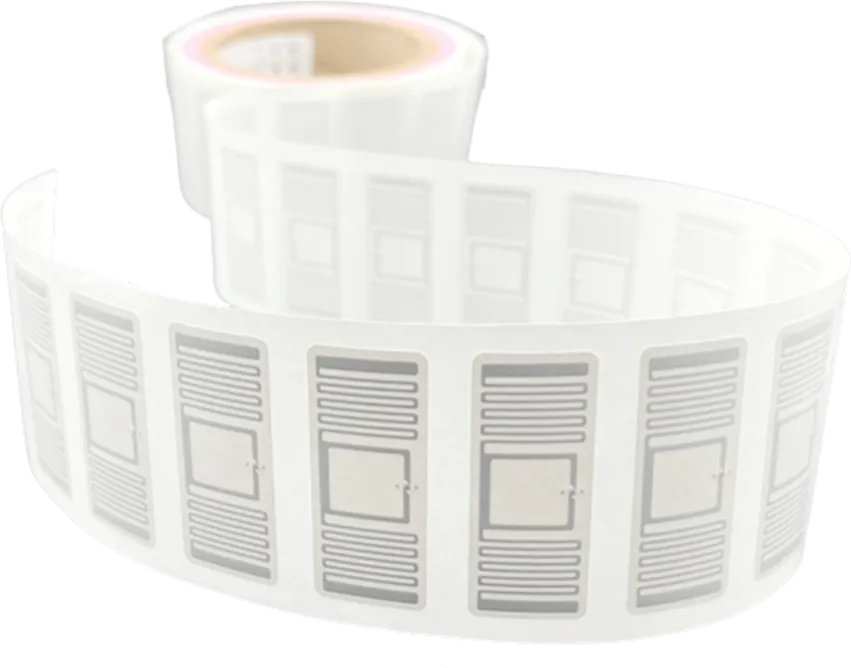
Since 20 July 2026, the central registry for the Digital Product Passport (DPP) has been operational. A few days earlier, the European Commission listed the first six harmonised DPP standards in the Official Journal. The framework is in place. In projects, a very practical question now comes to the fore: which data carrier reliably links the physical product to its digital passport throughout its entire lifecycle?
The data carrier is the bridge between product and passport
The Ecodesign for Sustainable Products Regulation (ESPR, EU 2024/1781) connects every product passport to a unique product identifier via a data carrier. EN 18220 defines the requirements for these carriers. They apply to 2D codes such as QR and Data Matrix as well as to RFID in HF, NFC and UHF | RAIN. The identifier itself is covered by EN 18219, for example as a GS1 Digital Link URI.
The QR code is the obvious starting point: low-cost, printable and readable by any smartphone. In practice, it hits two limits. Every read is a single scan that needs line of sight. And a code can be copied at will, so even a copy on a counterfeit leads to the genuine passport.
One passport, very different readers
A product passport is read over years, by stakeholders with opposing requirements. In production, warehousing, distribution and stores, throughput is what counts. Cartons, cages and shelves need to be captured in bulk without line of sight. That is the domain of UHF | RAIN RFID labels to ISO/IEC 18000-63. Consumers, service technicians, repair shops and recyclers, on the other hand, need targeted single-item access via smartphone: the domain of NFC tags and labels.
A single technology serves both worlds only with compromises. Two separate tags double material, application and data maintenance. They also create two identities that must stay in sync for good.
CT Dual Label: one identity across both interfaces
The CT Dual Label from CRAFT Technologies brings both worlds onto one chip. At its core is the EM4425 (em|echo-V) from EM Microelectronic. It combines UHF to EPC Gen2v2 / ISO/IEC 18000-63 and HF to ISO/IEC 15693 and NFC Forum Type 5 on a single die. Both interfaces access a shared, configurable 2,048-bit memory. The same chip serial number is embedded in the 64-bit UID on the HF side and the 96-bit TID on the UHF side.
For the DPP, this means the EPC (up to 480 bits, for example as an SGTIN) and the link in the NDEF record carry the same product identity. The warehouse reads in bulk, the consumer taps with a smartphone, and both reach the same record. No app is required, because common NFC-enabled smartphones open the NDEF link directly.
Authenticity of the data carrier: the gap the standards leave open
The DPP standards primarily protect the data. Authenticity and integrity of passport data are addressed by the complementary EN 18246. Cryptographic security features of the data carrier itself, however, are explicitly outside the scope of EN 18220 and EN 18246.
This is where the EM4425 comes in. Its AES-128 hardware generates dynamic NDEF messages that a backend can verify with every tap, with no app and straight from the browser. On the UHF side, the AES-based crypto suite to ISO/IEC 29167-10 is available. This makes it possible to check whether a passport belongs to a genuine data carrier on a genuine product. For brand protection, product verification and returns checks, that is added value beyond the minimum requirements.
Where the dual label plays to its strengths in DPP projects
- Textiles and apparel: bulk reading in distribution and stores, NFC access to material, care and repair information. Textiles are among the first product groups in the ESPR working plan.
- Consumer goods and electronics: registration, warranty and repair history with a tap, inventory management via UHF.
- Returns and circular economy: automated identification in reverse logistics and sorting, material data for the next life cycle.
- Brand protection: authenticity checks at the point of sale or in resale.
Technical specifications
- Chip: EM Microelectronic EM4425 (em|echo-V)
- Frequencies: 13.56 MHz (HF | NFC) and 860–960 MHz (UHF | RAIN)
- Standards: ISO/IEC 18000-63, EPC Gen2v2, ISO/IEC 15693, NFC Forum Type 5, ISO/IEC 29167-10
- Memory: 2,048 bits, configurable (EPC up to 480 bits, HF/UHF user memory)
- Security: AES-128 authentication (NFC web authentication, UHF crypto suite)
- Dimensions: label 45 × 25 mm, antenna 40 × 20 mm
- UHF read range: up to 10 m, depending on reader, environment and surface
- Operating temperature: −20 °C to +50 °C
- Format: dry inlay or self-adhesive label, white
- Options: pre-printing, encoding, custom formats
- Compliance: CE, REACH, RoHS
Outlook
The Digital Product Passport becomes mandatory product group by product group. For batteries it applies from 18 February 2027, and delegated acts for textiles and further groups follow in the coming years. Choosing the data carrier today shapes how efficiently processes will run and how robust the link between product and passport will be. A dual-frequency label is no substitute for a data strategy. But it makes the passport readable where it is needed: in bulk and in hand.
IDCRAFT supports DPP projects from chip and label selection through memory layout, key management and printing and encoding to reader integration and pilot projects.
Planning a DPP pilot? Get in touch: sales@idcraft.com · +49 6236 4494 685
FAQ
Is RFID permitted as a data carrier for the Digital Product Passport?
Yes. The harmonised standard EN 18220 covers RFID in HF, NFC and UHF alongside QR and Data Matrix codes. Which carriers apply to a specific product group is defined in the delegated acts. For batteries, the Battery Regulation requires a QR code; RFID can complement it there, but not replace it.
Can smartphones read the CT Dual Label?
Yes. The HF interface operates to ISO/IEC 15693 and NFC Forum Type 5. NFC-enabled smartphones read the NDEF link without an additional app, and the AES-based web authentication also runs in the browser.
Do I need two tags for NFC and UHF?
No. One CT Dual Label covers both frequency bands. Both interfaces share memory and chip serial number, so a single product identity is reachable via UHF reader and smartphone alike.
Sources: Commission Implementing Decision (EU) 2026/1736; EN 18220:2026; Commission Implementing Regulation (EU) 2026/1778 (DPP Registry); Regulation (EU) 2024/1781 (ESPR); EM Microelectronic, em|echo-V product information (as of September 2026).


