


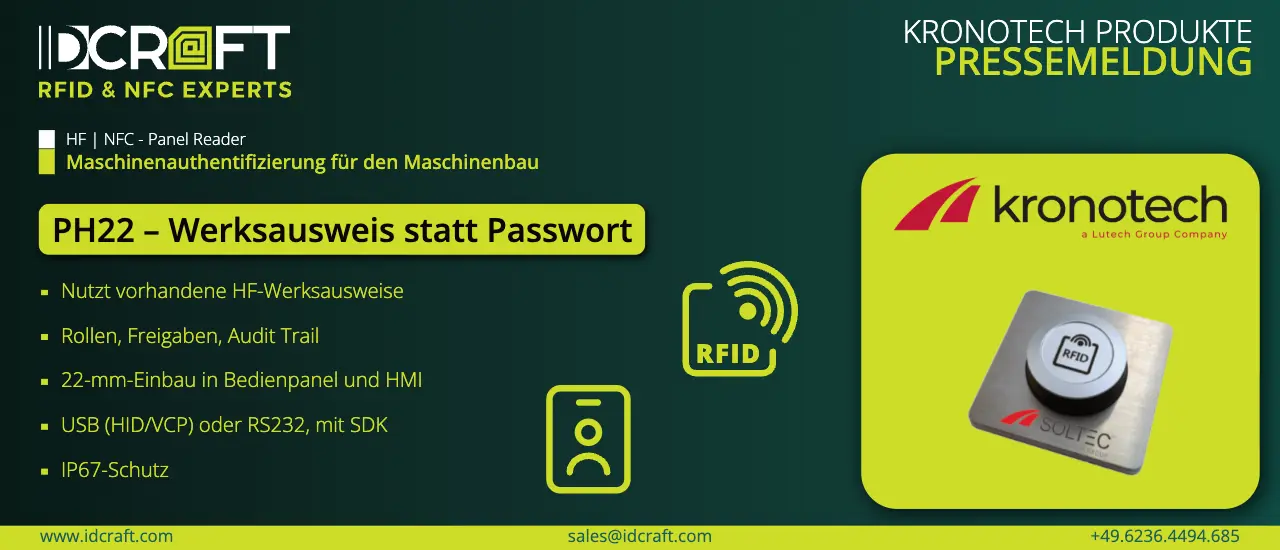
On many machines, a password at the HMI or a key switch still decides who changes the operating mode, edits parameters or releases maintenance. Neither holds up in shift work: passwords get shared and written down, keys are handed around or simply stay in the cabinet. Afterwards, nobody can say who did what.
Why this is landing on desks now
The EU Machinery Regulation (EU) 2023/1230 applies from 20 January 2027 and replaces the Machinery Directive. It makes cybersecurity part of CE conformity: control systems have to withstand foreseeable malicious attempts, safety-related software and data must be protected against corruption, and interventions have to stay traceable. IEC 62443 goes further and requires unique identification and authentication before access is granted. In regulated industries, a complete audit trail is expected on top of that. For machine builders this means operator authentication belongs in the design, not in a retrofit.
Why HF at 13.56 MHz fits
The read range in the HF band is short and well defined. A badge is presented deliberately, neighbouring cards are not picked up by accident, and current transponders bring cryptographic methods onto the card. The practical argument weighs more, though: in most plants the badges are already in people's pockets for access control, time recording and the canteen. Put machine login on the same medium and nobody needs a second credential system. Which RFID cards and key fobs are already in use decides the frequency, not the other way round.
What the Kronotech PH22 brings to the panel
The Kronotech PH22 is a panel reader built for exactly this mounting point. It is designed for the 22 mm mounting concept and therefore sits where control cabinets, operator panels and panel PCs already have a cut-out. It reads 13.56 MHz and 125 kHz, and the integrated antenna achieves read ranges of up to 30 millimetres.
For integration there is USB Type A, either as a virtual COM port or in HID mode, plus RS232, which covers older controllers as well as the industrial PC. The bundled SDK ships documentation, command protocols and a working Windows demo application, and supports Windows as well as Linux. The front side is certified to IP67. Further stationary form factors are listed under NFC readers, and the overview of RFID readers compares the device classes.
Typical applications on the machine
- Mode selection between automatic, setup and service restricted to authorised people
- Roles for operators, setters, maintenance and external service staff
- Release of recipes and parameter sets at the line
- Maintenance and service access with a record of who released what, and when
- Shift changes without typing: present the badge, gloves on
What to settle early
Personal login at the machine is subject to works council agreement in Germany. Purpose limitation and data minimisation belong in the planning phase, not in commissioning. The same goes for the question of which credential the operator already runs, and whether login is based on the card number alone or cryptographically secured.
In short
Access protection at the machine is moving from a nice extra to a requirement. An HF panel reader in the 22 mm cut-out is the smallest building block for roles, releases and traceability, and it spares the operator a second credential system. Samples and project pricing for the Kronotech PH22 are available on request.


