


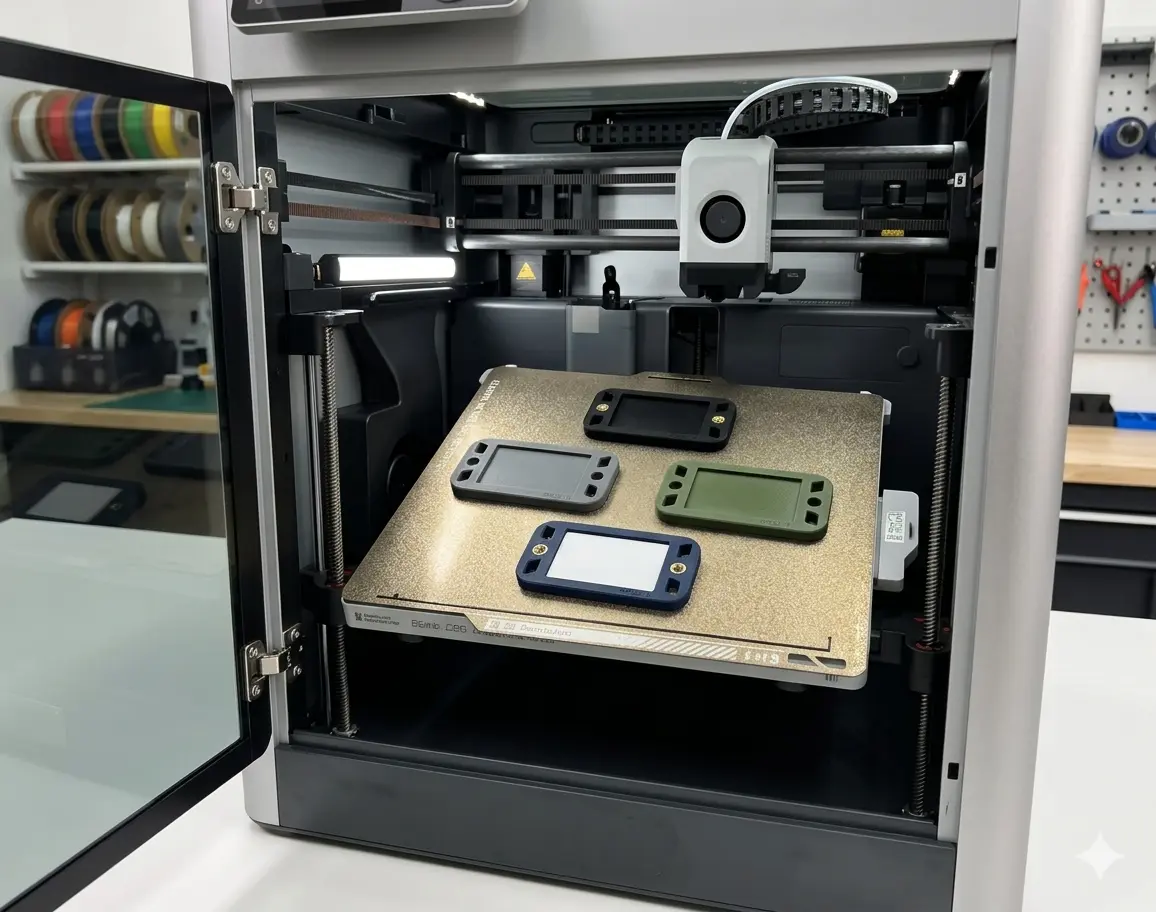
IDCRAFT uses the FDM 3D printing process (Fused Deposition Modeling) to manufacture custom transponder enclosures. Plastic filament is heated and processed layer by layer. At a defined point during the printing process, the RFID inlay - consisting of chip and antenna - is inserted and subsequently fully sealed within the enclosure. The finished RFID tag is completely protected and ready for immediate use.
The decisive advantage over conventional injection molding: no expensive tools or molds are required. This makes even small and medium quantities economically viable. The design freedom of 3D printing enables custom form factors, adapted mounting elements such as M5 threads or cable tie loops, and project-specific geometries that would be impossible with standard transponders.
At IDCRAFT, you receive not just the 3D print but the complete RFID package: we design the transponder, select the right inlay, test the read range, and encode or personalize the finished RFID tag. As an RFID distributor, we combine 3D printing, RFID know-how, and project support - an approach that is particularly valuable for companies that need custom transponder solutions without building their own development resources.
.png)


