


Where every piece is still scanned
At the workwear return counter, at the Kanban collection box on the shop floor or at the PPE issue point, capture often runs the same way: pick up the item, find the barcode, scan, next item. With a full laundry bag that takes a while, and a piece scanned twice or not at all only shows up when the counts are reconciled.
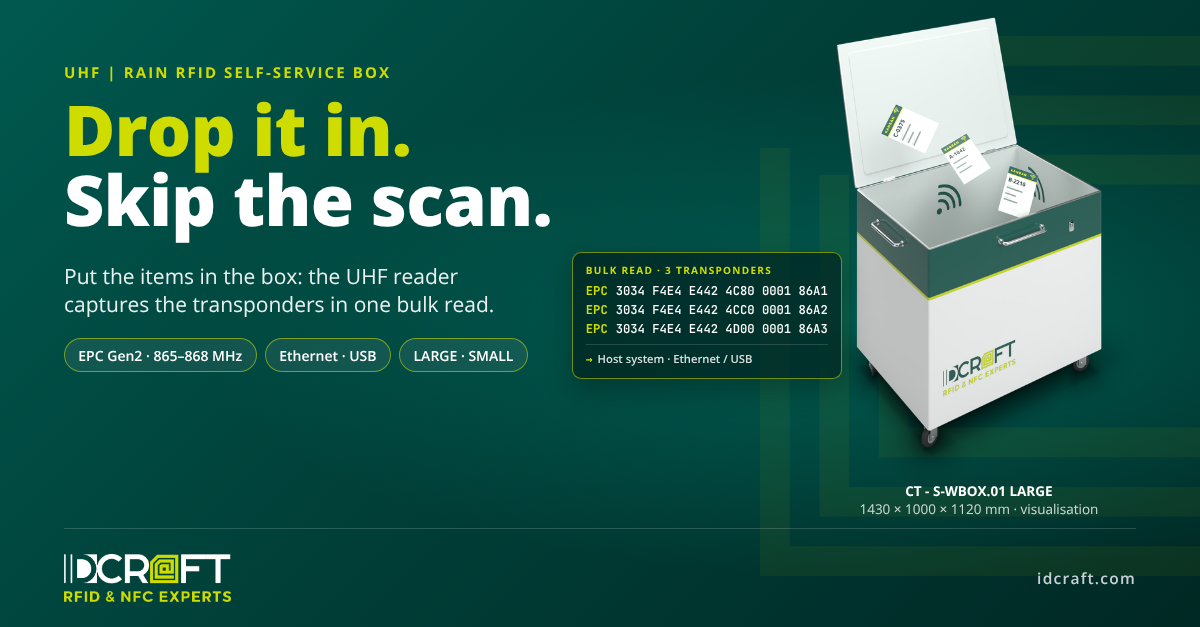
UHF | RAIN RFID needs no line of sight. Using the Gen2 protocol, the reader queries the transponders in the field in quick succession and separates their replies through anti-collision. The CT - S-WBOX.01 is built for exactly this step: a mobile box with an integrated UHF reader that you put the items into.
How the box works
- Put the items in. The UHF transponder sits in or on the item, for example as a laundry tag in the hem or as a label on the Kanban card.
- Bulk read. In the LARGE version, four UHF antennas around the interior are connected to the integrated reader. The reader captures the transponders of the items in the box in one pass.
- Recording in the host system. The EPCs go via Ethernet or USB to a PC or kiosk terminal on site. There, the business logic decides what the read turns into: trigger replenishment, record a return, confirm an issue.
The user interface and business logic therefore stay with the customer. The box delivers the reads. The software that already manages the inventory decides whether an employee first signs in at the terminal with their badge, whether a receipt is printed, or whether only EPCs added since the box was last emptied count.
Example e-Kanban: card in, replenishment out
In classic Kanban, every bin carries a card. When the bin is empty, the card goes into a collection box, and someone takes the cards to the planners or scans them in. With RFID e-Kanban, the card carries a UHF label. Once it lands in the S-WBOX.01, the reader picks up its EPC and the host system triggers replenishment for exactly that item and loop.
The same works with the bins themselves: when an empty bin with a transponder comes back, the read provides the replenishment signal. On plastic bins a UHF label is usually enough; metal bins need an on-metal transponder. An overview is under UHF RFID tags and labels.
Plan for two things. When many cards lie exactly on top of each other, the label antennas couple and detune each other, so we set card thickness, label position and chip in a test with a stack of real cards. And because the cards stay in the box until it is next emptied, the host system has to know which EPCs have already been reported. We print and encode the labels for the cards, such as the CT RFID Label, with no minimum order; the card number goes on the label in plain text and into the EPC.
Example textiles, PPE and rental items
In workwear and uniforms, the transponder usually sits in the hem or in a sewn-in label. Whoever returns clothing puts it in the box, and the host system records the return against the employee or the cost centre. For textiles that go through industrial laundering there is the CT Laundry Tag Series: 20 UHF | RAIN laundry tags with NXP UCODE 9xe or Impinj M830, sewn, heat-sealed or hang-on, rated for 200 industrial wash cycles at 90 °C or three years, whichever comes first.
The same pattern applies to hospital and cleaning textiles, to the issue and return of personal protective equipment and to rental items: here too, tagged items go into the box instead of being scanned one by one. Cleaning textiles such as mop covers often come back damp, and water attenuates UHF; metal parts can shield or detune the transponder. Test both before choosing the transponder.
Technical data
- Technology: UHF | RAIN RFID, EPC Gen2 / ISO/IEC 18000-63
- Frequency: 865–868 MHz (EU)
- Reader: integrated
- Antennas (LARGE): 4 × UHF, around the interior
- Interface: Ethernet or USB to the host system
- Dimensions LARGE: 1430 × 1000 × 1120 mm (L × W × H), 2120 mm high with the lid open
- Dimensions SMALL: 600 × 600 × 600 mm
- Mechanics (LARGE): four castors, hinged lid, handles on the front and both sides
- Scope of supply: box, UHF reader, antennas, power supply, cabling
- Not included: PC or kiosk terminal for the user interface
What to settle before a project
- Transponder: Which transponder suits the item, and where does it sit? Textiles need laundry tags, Kanban cards a label, metal parts an on-metal transponder.
- Fill: How many items lie in the box at once, and how densely? Transponders lying directly on top of each other couple, water attenuates, metal reflects.
- Surroundings: If tagged goods stand close to the box, the reader can also see transponders outside it. How far the box reads beyond its walls depends on transmit power, antennas and location.
- Host system: Which system receives the EPCs, and what does it record? The PC or kiosk terminal is not part of the scope of supply.
- Size: LARGE takes laundry bags and bins, SMALL suits cards and small parts.
We go through these points with you and real parts from your operation before a project starts. The UHF Tag Finder filters UHF transponders by surface, read range and temperature; form factors and chips are compared under RFID tags and transponders.
Request a project
Send us the application, the items, the number of items per return, any transponders already in use and your host system. We tell you which version and which transponder fit, and quote the project price.
Request a project: Inquiry for the CT - S-WBOX.01 · Product page and datasheet
Frequently asked questions
Which transponders does the box read?
UHF | RAIN transponders to EPC Gen2 / ISO/IEC 18000-63 in the European 865–868 MHz band. It does not read HF | NFC transponders or barcodes.
Are all items in the box captured?
That depends on the transponder, its position on the item and how densely the items lie. That is why we test with your items before the project.
Does the box need a PC?
Yes, or a kiosk terminal. The box passes the reads to the host system via Ethernet or USB; the PC or terminal is not part of the scope of supply.
Does the box also read transponders outside it?
With UHF that is possible when tagged goods stand close to the box. How far the box reads beyond its walls depends on transmit power, antennas and location; that belongs in a test at the site of use.
Which size do I need?
LARGE (1430 × 1000 × 1120 mm) with four antennas, castors and hinged lid for textiles and bins; SMALL (600 × 600 × 600 mm) for smaller quantities and parts such as Kanban cards.
What does the box cost, and when is it available?
We quote project price and availability on request, depending on version and quantity.


